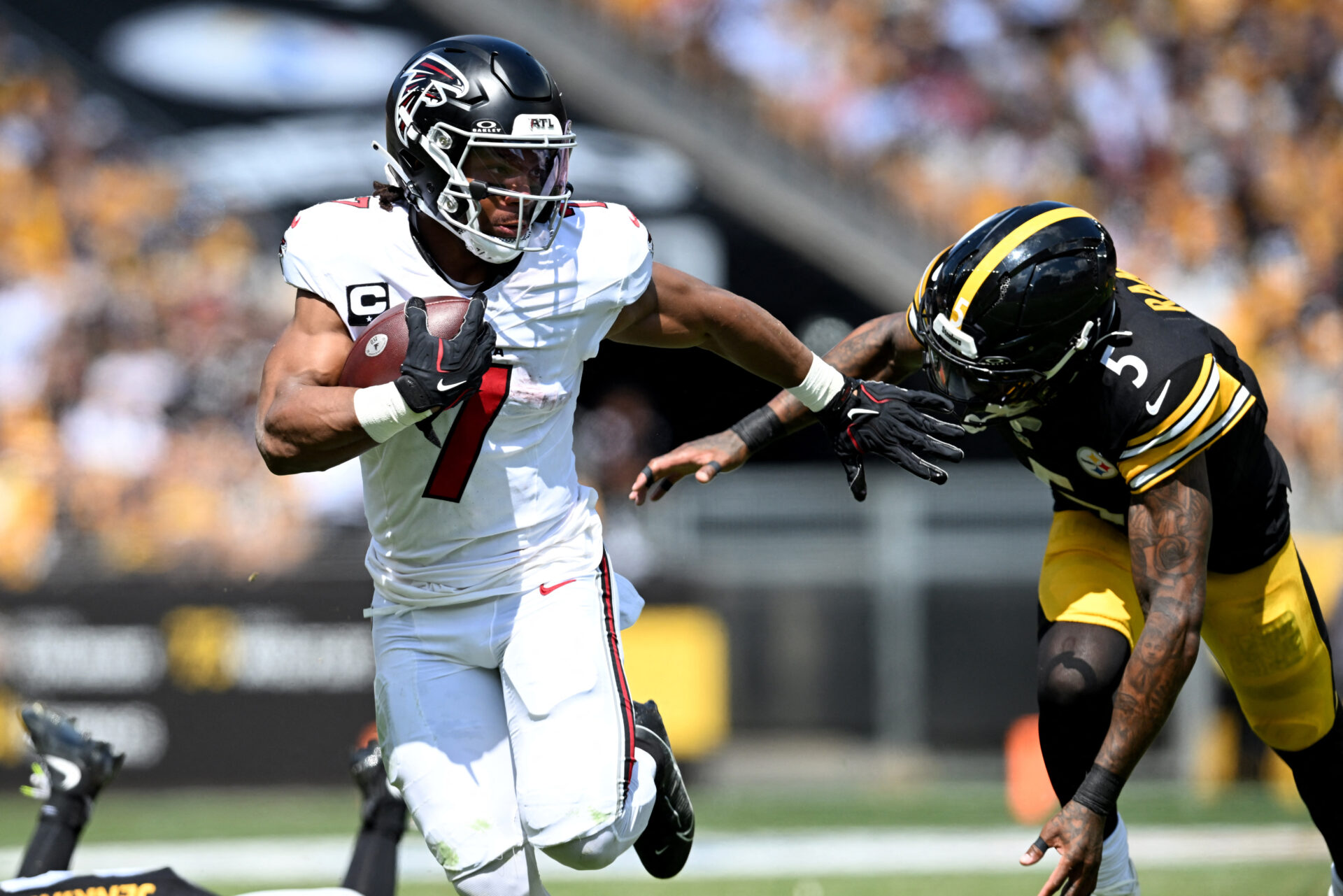
Robinson finished Week 1 with 173 yards from scrimmage and a touchdown, a stat line that immediately placed him in the top tier of impactful players for the Falcons. His ability to contribute as both a traditional/running back and a versatile receiving option has given Atlanta an exciting new dimension on offense. The youngster’s display hinted at a broader, more dynamic schematic approach for the Falcons, one that leverages his unique skill set to stretch defenses horizontally and vertically.
In a revealing interview, Robinson discussed his inspirations and the path that shaped his play style. He spoke candidly about modeling his game after Hall of Famer Marshall Faulk, a cornerstone of the St. Louis Rams’ high-powered offense in the late 1990s and early 2000s. Faulk’s dual-threat impact—combining running, receiving, and pass protection—redefined the running back position and helped propel the Rams to elite offensive production. Robinson’s admiration for Faulk centers on the way Faulk blended running discipline with elite hands and route-running, making him a constant factor no matter where he lined up on the field.
Robinson’s comments reflect a broader strategic aim: to become a multi-positional weapon who forces defenses to adjust continually. By emphasizing versatility, he positions himself as a player who can destabilize coverage schemes, create mismatches in the passing game, and open rushing lanes with his decisiveness and contact balance. That approach aligns with modern NFL offenses that prize backfield players who can attack defenses on the edges and over the middle with equal effectiveness.
The Falcons’ Week 1 performance by Robinson illustrated the potential payoff of that strategy. He totaled 83 rushing yards and 90 receiving yards, contributing the Falcons’ lone touchdown in a game that highlighted his capacity to influence the outcome in multiple phases. His early-season success is a positive signal for Atlanta as they look to build a more robust and unpredictable offense, particularly as they seek to maximize their offensive efficiency in environments where quarterback stability has been a longstanding challenge.
Beyond individual numbers, Robinson’s emergence stands as a sign of how quickly he has adapted to the NFL’s pace and physicality. The transition from college star to NFL contributor can be steep, but Robinson has demonstrated the vision, balance, and receiving savvy that allow for rapid impact. His repertoire includes the acceleration to rip through seams in zone schemes, the patience to read second-level defenders, and the reliable hands that turn check-downs into positive gains. These traits make him a constant factor for defenses to account for, which can free up other playmakers and spark more balanced offensive production for Atlanta.
The Falcons are keen to leverage Robinson as a centerpiece of their offense as they navigate the regular season. A major objective is to translate Week 1 success into sustained production and a playoff push—an objective that requires growth across the quarterback position and the overall unit. If Robinson continues to develop the dual-threat skill set that has drawn comparisons to Faulk, Atlanta could unlock more consistent scoring opportunities and lengthier offensive drives, creating an environment where the offense remains multifaceted and difficult to defend.
As the season progresses, Robinson’s development will be closely watched by fans and analysts who value the strategic edge he brings. His early-season impact provides a blueprint for how a modern back can be used to maximize efficiency, whether lined up in the backfield, out wide, or in the slot. The hope is that Robinson’s trajectory mirrors some of the historic success seen by Faulk in shaping a dynamic, pass-friendly offense that remains dangerous on the ground as well.
In summary, Bijan Robinson’s Week 1 performance confirmed his status as a cornerstone piece for the Falcons’ offense. His 173 total yards from scrimmage and the scoring ability he displayed establish him as a player capable of changing games and shaping the Falcons’ offensive identity as they move deeper into the season. While questions about quarterback consistency linger, Robinson’s versatility and playmaking ability provide a compelling foundation for Atlanta’s aspirations of returning to postseason contention.