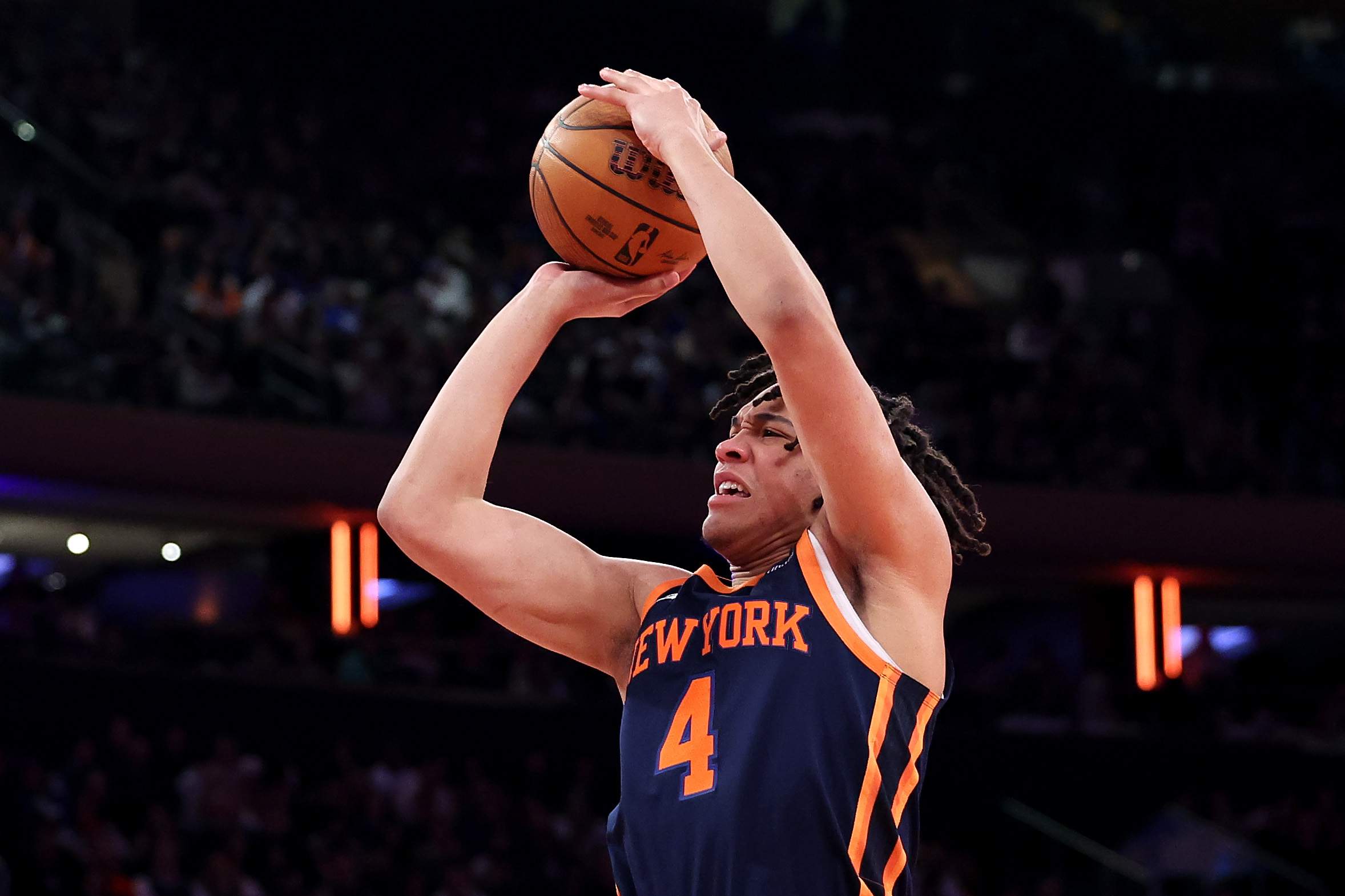
The offseason has kept Brunson in the public eye beyond basketball courts and arenas. He’s been photographed and spotted at a variety of high-profile events, from major wrestling shows and charity golf outings to appearances at iconic basketball venues like Rucker Park. With every public appearance, conversations about Brunson’s impact, leadership, and future continue to evolve.
One recent, high-profile debate centers on a bold take about how Brunson stacks up against Shai Gilgeous-Alexander, the back-to-back NBA MVP and rising star. The discussion originated from a podcast episode featuring Max Kellerman and Rich Paul, where Kellerman presented a provocative comparison between Brunson and Gilgeous-Alexander based on a particular playoff run.
In the debated segment, Kellerman framed a “real-world experiment” scenario: Brunson and Gilgeous-Alexander play the same position and operate within similar offensive systems, facing the same opponent, the San Antonio Spurs, in the playoffs. He argued that the Spurs’ defensive approach against SGA worked in their favor in one series, but Brunson was able to adapt and overcome in theirs, suggesting Brunson’s higher value or ceiling.
The exchange also included a discussion about basketball IQ, heart, and resilience. Kellerman emphasized Brunson’s “basketball brain”—his ability to read and react under pressure—while Rich Paul highlighted Brunson’s mental fortitude and the importance of clutch performance. The dialogue evolved into a broader comparison between Brunson and Gilgeous-Alexander, vowing to weigh not only raw numbers but also intangibles that influence a team’s success in late-game situations.
From a statistical standpoint, Brunson’s 2025-26 season continued his ascent. In his fourth year with the Knicks, he averaged around 26 points per game, roughly 6.8 assists, and about 3.3 rebounds, while knocking down an average of 2.6 three-pointers per game. He earned All-Star recognition and secured a second-team All-NBA nod for the third year in a row, underscoring his status as one of the premier guards in the league. Notably, his scoring average tended to rise during the playoffs, a pattern that has become a hallmark of Brunson’s career, signaling his ability to elevate his game when it matters most.
Shai Gilgeous-Alexander, meanwhile, brings a storied resume marked by multiple regular-season MVP awards and a Finals MVP trophy from a prior championship run. In the same season, Gilgeous-Alexander posted strong scoring numbers, ranking near the top of the league in points per game and maintaining a remarkable streak of 20-point games. His clutch performances have also defined his career, making him one of the most trusted players when the stakes are highest.
The juxtaposition of Brunson and Gilgeous-Alexander is not merely about head-to-head statistics, but about impact in different contexts. Brunson’s leadership helped the Knicks achieve championship success, leveraging experience, timely decision-making, and resiliency. Gilgeous-Alexander’s career has been marked by consistent scoring, playmaking, and a history of stepping into and thriving in high-pressure environments, including MVP-caliber campaigns and a Finals MVP accolade for his team in a previous season.
Ultimately, evaluating who is “better” between Brunson and Gilgeous-Alexander depends on the criteria one prioritizes. If one weighs leadership, playoff performance, and the ability to elevate a team through tough moments, Brunson’s recent track record provides compelling evidence of his value. If one emphasizes sustained scoring dominance, late-game efficiency, and a broader trophy cabinet, Gilgeous-Alexander offers a different, equally impressive set of credentials.
Regardless of the outcome of hot-take debates, Brunson’s trajectory with the Knicks has solidified his status as a transformative player for New York basketball. His offseason visibility—whether at charity events, media appearances, or community engagements—continues to reinforce his role as a central figure in the NBA’s ongoing narrative. As the league moves into a new season, fans will closely watch how Brunson builds on his championship pedigree and how his game evolves in response to new coaching strategies, opposing defenses, and the evolving dynamics of a highly competitive conference.