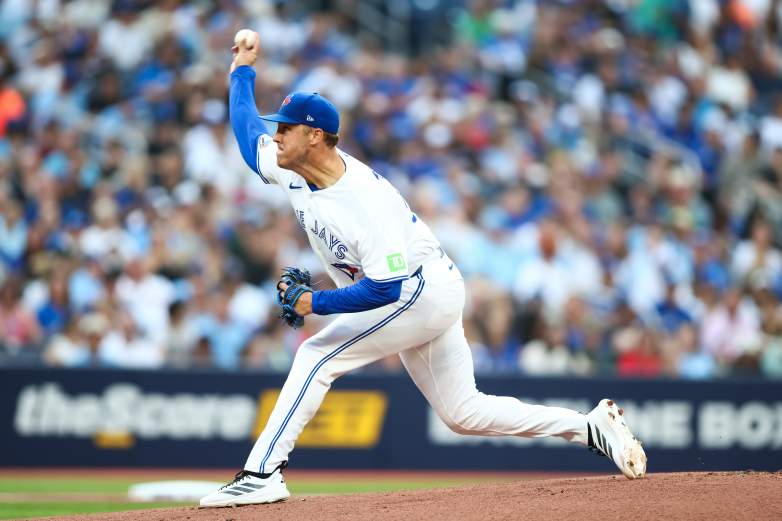
Watson’s return marked a pivotal moment for a pitcher who had spent almost the entire season on the injured list. The team’s decision to bring him back and assign him a start on the evening of his activation underscored how closely the organization is watching his development. Before this week, the Mets had been weighing the long-term plan for Watson since spring, with the hope that his talent would translate into a sustained path toward a major league role.
Background and profile
– Watson, 23, was selected in the seventh round out of the University of Southern California. He signed with the organization for $281,300 in July 2024.
– On the mound, Watson delivers from a low three-quarters slot, featuring a long, whip-like arm action. His fastball sits in the mid-90s, typically around 94-96 mph, and can touch 97 mph. This velocity level represented a notable jump from his college days and has persisted into his professional career.
– His primary breaking ball is a mid-80s slider, a weapon that has helped him against right-handed hitters. He also uses a fading changeup to complement his repertoire against left-handed hitters.
– The Mets have consistently viewed him as a potential starter, though his command development remains a critical factor in determining whether he can sustain a longer role in a rotation or if a bullpen path might be more viable.
Injury timeline and rehab
– The oblique issue that sidelined Watson began around May 5, as he faced a difficult inning that included allowing a grand slam. The ensuing strain prompted him to land on the 7-day injured list and later the 60-day injured list, delaying his progression.
– Upon activation, he immediately began rehab assignments, starting at Single-A St. Lucie on Aug. 2, and later moving to High-A Brooklyn on Aug. 20. The rehab trail provided mixed results: Watson posted a six-inning, scoreless stint over three appearances for St. Lucie, followed by a rough outing in Brooklyn that lasted just a couple of innings.
– Prior to the injury, Watson had already encountered a rough stretch in 2026, beginning the season back at Double-A with an 0-5 record and an 8.55 ERA over six starts. He issued 12 walks while recording 19 strikeouts across 20 innings, and his velocity was down from his 2025 breakout. The club’s coaching staff characterized the early-season struggles as a period of adjustment, during which Watson had to rely more on pitching to contact rather than overpowering hitters.
Prospect status and organization view
– Watson’s prospect ranking rose quickly after moving through the system. In 2025, he began at Single-A St. Lucie, reached High-A Brooklyn by June, and closed the year with a stint at Double-A Binghamton, ending with solid overall numbers. His high strikeout total and ability to miss bats remained a hallmark of his profile.
– Control, however, has been an enduring concern. Since turning pro, Watson has carried a double-digit walk rate at every stop, a factor that has tempered his ceiling in the eyes of evaluators.
– MLB Pipeline and other prospect trackers have noted that his future could hinge on improved command. Some assessments have suggested that if command doesn’t coalesce, a bullpen role might be more likely than a traditional starter path.
Recent performance context
– The Mets have long-term plans for Watson as a potential contributor either in a rotation or in a leverage role out of the bullpen. The immediate aim of the rehab and the subsequent minor league start is to provide evidence that his stuff remains potent and that command can be refined under competitive game conditions.
– The September innings will be highly informative for the organization, as performances in the final stretch of the season often guide decisions about roster depth and organizational prioritization for the following year.
What this means moving forward
– If Watson demonstrates the same velocity and a more consistent strike-throwing ability in his next appearances, he could be considered for a more prominent role in the organization’s pitching depth chart heading into 2027.
– The decision points will include not only his raw stuff but how well he commands the zone, how efficiently he can sequence his pitches, and how effectively he can mix his slider with his changeup against different hitters.
– The Mets will likely monitor his workload carefully to ensure sustainable development while avoiding a relapse in the elbow or shoulder mechanics.
In summary, Will Watson’s return from injury marks a critical checkpoint in a season that has tested his resilience and command. His performance in the remaining minor league games this season will help determine whether he projects as a future major league starter or potentially contributes as a high-leverage reliever. The organization’s focus remains clear: maximize his ceiling while ensuring a durable, long-term contribution to the pitching staff.