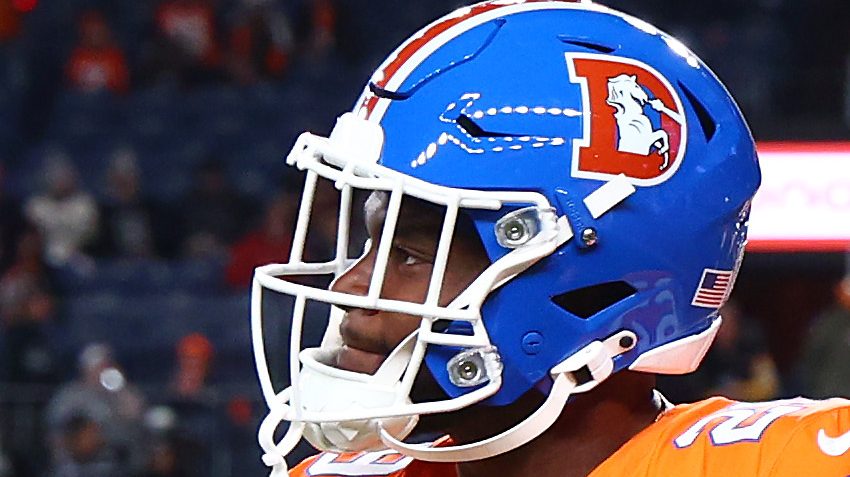
Jonah Coleman emerged as a standout during the Broncos’ offseason activities, drawing projections that he could contribute sooner rather than later. Drafted with the 108th overall pick after the team traded assets earlier in the offseason, Coleman quickly established himself as a promising multi-dimensional back. His early showing suggested he could handle multiple responsibilities, including pass protection, receiving out of the backfield, and offense-wide urgency in both the rushing and passing games.
Analysts and observers highlighted Coleman as a potential complement to the established backfield. Within the team’s running-back group, Dobbins sits atop the depth chart, with RJ Harvey providing a powerful complement and Coleman showing enough versatility to operate in a rotational role. The expectation is that Coleman’s ability to contribute in the passing game, along with his quickness and contact balance, could help Denver maintain efficiency even when the offense rotates its backs.
Dobbins himself spoke positively about the new teammate, noting that Coleman is built with a strong work ethic and a daily readiness that suits the Broncos’ program. Reports from beat writers and national outlets described Coleman as a back with quickness and reliable recognition in pass protection, two traits that are particularly valuable for a rookie who needs to contribute early on special-receiving packages and on third-down plays. The early buzz suggested Coleman could be a reliable third-down option who can stay on the field in various packages, allowing Denver to preserve Dobbins’ energy for critical late-game drives.
Coleman’s skill set also extended to the passing game, where he displayed an ability to create separation and align well with the team’s passing concepts. His versatility was emphasized by observers who noted his capability to impact the offense both as a receiving option and as a blocker in pass protection. This two-way potential made him an appealing addition to a squad seeking more unpredictability in its backfield during a season when securing multi-faceted playmakers is key.
The arrival of Coleman creates a compelling dynamic for the Broncos’ backfield depth, particularly given the recent history at the position. Last season underscored some vulnerabilities when the primary back missed time, and the team’s performance in the running game fluctuated as a result. Evaluations at the time highlighted the importance of having a dependable trio that could sustain pace and power across different game scripts. Coleman’s inclusion is seen as a prudent move to help Denver maintain rhythm in the backfield, whether through conventional rushing plays or through passing-game schemes that rely on fluid route combinations from running backs.
RJ Harvey entered the offseason with notable receiving ability, but questions persisted about his effectiveness as a runner, especially when the offense required balance in the ground game. A shoulder surgery sidelined him briefly, but the plan has been for Harvey to be fully healthy and available for training camp. Still, the optimism around Coleman’s progress and Harvey’s evolving skill set suggests Denver could deploy a more versatile trio that can adapt to different game plans and opponent strengths.
Beyond Coleman, the Broncos’ broader approach to their rushing game emphasized sustained improvement through scheme and leadership changes. The transition in play-caller duties to Davis Webb was cited by many as a potential catalyst for better-ground production. Analyses indicated that the late-season efficiency in the running game could hinge on rhythm and the ability to sustain drives, with the team looking to carry that momentum into the new season. In this context, the potential impact of Coleman and the continuity of a healthy Dobbins are central to Denver’s strategy to reclaim a more productive ground attack.
In evaluating the team’s overall offensive approach, the Broncos’ emphasis on a balanced attack and improved protection schemes is clear. The scouting and coaching staff have prioritized a backfield capable of sustaining efficiency in all phases—early downs, short-yardage situations, and third-down conversions. Coleman’s development in pass protection and his receiving reliability will be closely watched, as these facets determine how often he and the other backs can stay on the field together, creating a more dynamic and less predictable offense.
Looking ahead, the competition among the running backs appears poised to be healthy and productive. Dobbins remains the leading option, bringing a mix of power and vision. Harvey, with his receiving threat and improved health, provides a strong complement, while Coleman’s versatility could unlock additional matchups and depth. If Coleman can translate his offseason performance into consistent NFL-level execution, Denver would benefit from a more robust and flexible rushing attack that can adapt to defenses and late-game scenarios.
In summary, the Broncos’ plan to elevate their rushing efficiency centers on a three-pronged approach: maximize J.K. Dobbins’ ability to carry the workload, integrate RJ Harvey as a strong playmaking partner, and add Jonah Coleman as a versatile third-down and receiving back. The offseason program showcased Coleman’s potential to influence the offense in multiple ways, and his development will be a critical factor in how effectively Denver can sustain a productive ground game throughout the season.